


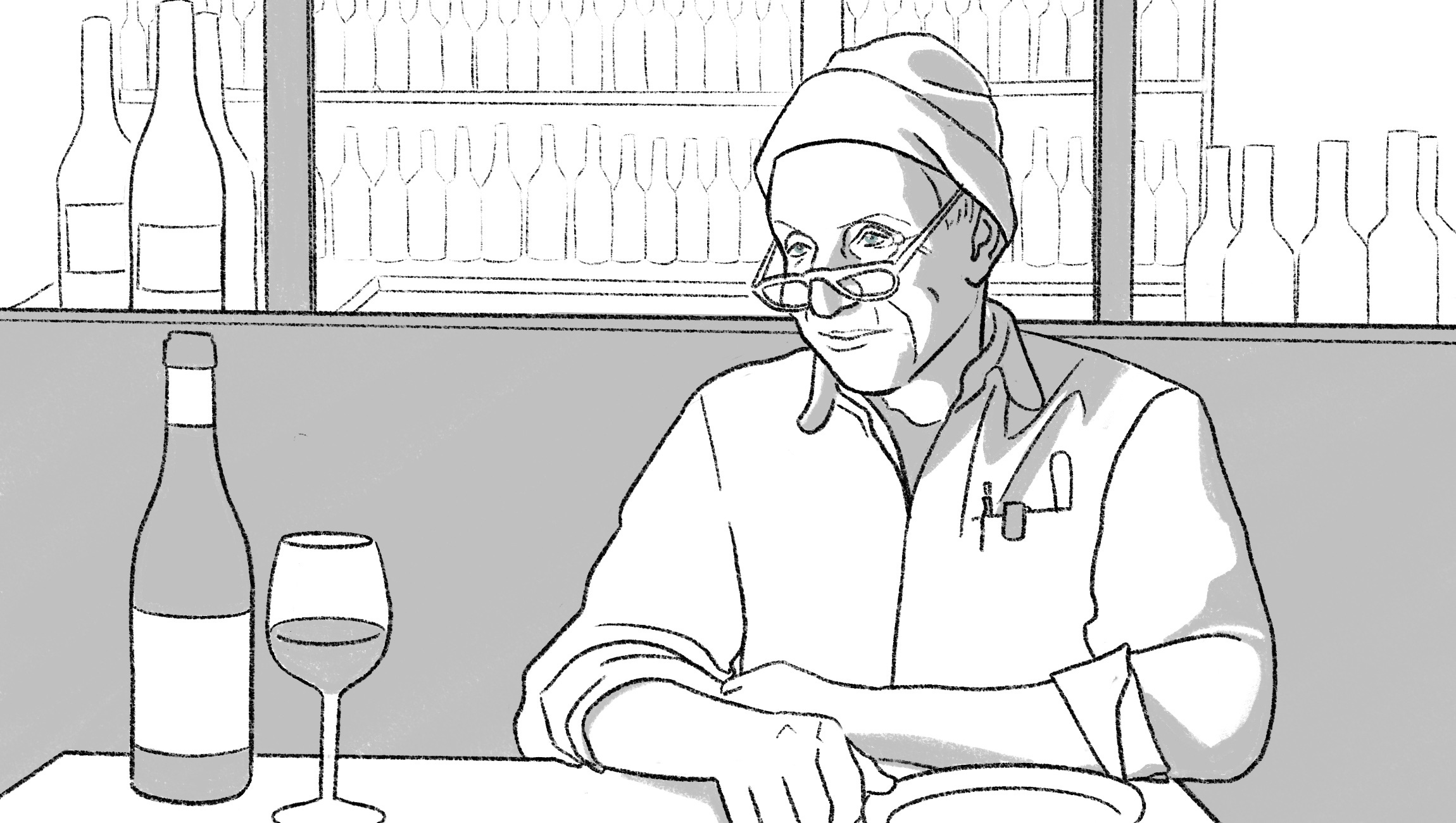
Baker. Grocer. Mensch. Eli Zabar is a man who needs no introduction, especially here in his hometown of NYC. We caught up with the OG Foodie (a term we are sure would make him bristle) in a corner booth at his eponymous UES spot Eli’s Table to talk Parisian power lunches, the transcendence of a simple, honest meal, and why he loathes black and white cookies.
My mother wasn’t a very good cook, and she didn’t cook many different things, but she made copious amounts. Dinner wasn’t complete without a couple of boiled chickens, couple of roasted chickens, then there would be boiled beef, and this is all the same meal. We had a house up in the country. There was a farmer across the road. My brother Stanley would run out and get the corn. They’d just picked it, you know, and he’d run home with it, and so we had corn, and there was always some vegetables and these platters of steaks, grilled steaks.
This was in Putnam County, in an area called Mohegan Colony. Mostly full of real lefties, communists. My parents would invite everybody to come over. We were in the food business, so we had tons of food, Sunday morning bagels and lox and white fish and herring, different kinds of herring, rye bread, thick sliced rye bread, all in copious amounts. Men would talk politics. It was loud. I was five, six years old. My parents spoke English to me, but spoke Yiddish among the group, and sometimes Russian. This was 1949, 1950, the war wasn’t so far behind. That’s my first association with food.
The first time I had real French food, in France, I was 17. I was with a friend of mine. We were on a bike trip through Europe. Stopping in little villages, sleeping where we could. I remember going to a grocery store. I remember buying a baguette and a Camembert, and I remember opening that Camembert. It had a kind of raw milk smell that I’d never experienced before. That slightly barnyard smell that comes from raw milk. It wasn’t even ripe all the way through. It had a little chalkiness, and still it was delicious. I was 17. We were on bikes. I was free.
The original La Petite Ferme was down in Greenwich Village, and it was owned by this French guy whose family came from Burgundy. Let me talk about this place, okay. It was down on, like, Charles Street, where the Village could still be extremely charming. It was very small, very few choices on the menu. And they had cuckoo birds. They had birds in cages that were cooing during the meal. I mean, it was very rustic. This was a gay guy who had extraordinary taste and everything was really delicious. It was so simple, like, big bowls of mussels in kind of a vinaigrette with red onion served at room temperature. Doesn’t sound interesting, but they were delicious. I loved that place. They eventually came up here to 71st on Lexington and it failed. But there was a time, you know, that Jackie Onassis went there. Society went there, but it was really, really good and full of its own style.
There was a place called Steinberg’s Dairy Restaurant between 81st and 82nd on Broadway. There was a time when, you know, in the 1920s, ‘30s, ‘40s, if you were Jewish and upwardly mobile, that’s where you lived. Riverside Drive. West End. Sometimes on Broadway. Otherwise over on Central Park West. That was the mecca of wealth. There were all kinds of restaurants and one of them was this dairy restaurant called Steinberg’s. They only made dairy. They made the most delicious blueberry blintzes, and they were crispy. They were fried. My mother made blintzes, and they were very good, but they were soft. Steinberg’s only made them with cheese. They made them with blueberries, and they served them with sour cream. That was absolutely delicious. I would go with my two brothers. I was a kid. It lasted until I was about 18.
I don’t think anybody should be at the table for more than an hour and a half or two hours. Unless you’re with the most boisterous, wonderful group of buddies, and then it doesn’t make any difference what you’re eating, right?
They had maybe a 20-foot mural. A mural, a painting, on the wall. It was very New York, very 1920s kind of WPA project from the Depression. It was of young people under the George Washington Bridge having a picnic. I remember it so well because in the end, when the restaurant closed and the building got sold, one of my brothers bought the building and took the mural. Now it’s in his dining room. Every time I go over there, I see it and it brings back memories.
We have a house down in the Provence area, and I have a big wood fired, kind of pizza oven that looks like it’s been there since the Middle Ages, but we actually installed it. It’s outside. I’ve never turned on the oven inside the house. I demand that everything we make has to be cooked in this oven. It’s kind of a discipline to make things the old way. If you want to bake pastry in this oven, you’ve got to wait to the very, very end when the fire has actually gone away, and the oven is still basically a little hot. And you know it by feeling it, by feeling the temperature. And let me tell you, I’ve screwed up so many things in that oven. I’ve burnt my bread a thousand times. I love it when Oliver comes. My sons Oliver and Sasha, they’re very careful. I’m burning things left and right, and they’re very careful. I make bread every day.
I used to be a slave to the bread making process. Because bread, bread doesn’t wait. Everything had natural yeast, a natural starter, sourdough, you know, when it’s ready, it’s ready. It’s like a soufflé. You’re ready for it. It’s not ready for you. I keep playing with the flour. I keep playing, playing with the grains. I get the amount of water and the amount of mother. It takes about five days for the mother—which has been sitting in the refrigerator since I left in September of the year before—to kind of revitalize itself. Maybe a week. Sometimes, after three days, I begin to think it’s dead and it’s not going to come back. I have sleepless evenings over that. And finally, it does, it does come back.
I’ve been yelled at so many times at markets in France. Thousands of times! I like to eat little things along the way. The French don’t like that. It’s not part of their culture. To give samples. It’s very rare. It’s not like when you go to farmers markets here in New York. I’ve gotten severely embarrassed. I mean embarrassed. Called out. I wish to disappear. I’ve been called out so many times that my wife won’t go with me to a market without a promise that I won’t touch anything.
It’s very hard to find fresh peas. You’ve got to take a pod or two, you know, stick your hand in and open it up, eat the pea. I mean, otherwise they taste woody. No, I taste everything as I’m going through the market.
There’s a big chocolatier in Zurich called Sprüngli. I walked in and on the shelf right behind one of the women working there they had challahs. So, okay, so I brought this challah. I ended up making bread pudding with in in Paris with Joanne. Johanne Killeen. She’s my wine wife. She owns Al Forno restaurant in Providence, Rhode Island, which is arguably one of the most delicious restaurants in America. They’re not actually in Providence. You’ve got to go over a bridge to get there. Her husband, George, who passed away about six or eight years ago, invented this grilled pizza. It’s very, very thin, and they do it on a grill, on a charcoal grill, and it burns a little bit. And they put all kinds of toppings on it. It’s a vernacular. It’s Italian. It’s, you know, Providence is like Italian. It’s Portuguese, but it’s like American Italian. George came from Yonkers, you know. He and Johanne, they’re not Italian, but they’ve spent so much time in Italy that they kind of married the most, finest, and delicious aspects of Italy with this, with the vernacular, the American vernacular of Italian food. So they come up with something that’s totally delicious. Portions are enormous. It’s a unique, unique place in America.
I had my birthday at Troisgros a few years back. And I’d say, of all of the quote ‘fancy restaurants,’ that one stands head and shoulders above every one of them. Why? Because it’s a family restaurant, and that kind of hospitality is true hospitality. They care about you, and they talk to you like they care about you and they treat you like they care about you, like you’re going into somebody’s home. There’s no other restaurant like it. It’s about an hour, an hour and a half southwest of Lyon. It’s famous, three Michelin stars, but I’m not interested in most of those kinds of meals. But I love this place. I went there for the first time when I was about 31 or 32 years old. The family had a hotel for many generations, and they had a restaurant downstairs. The father’s two sons had taken over the place and had built it into something very special. I remember staying there for four or five days. I told one of the two brothers, I said, ‘I’m in the business,’ even though I’d only been in business for a couple of years. He said, ‘well, come with me to market. If you can get up at five, we’ll go to the market together.’ He had a little French van, you know, and we went to the market. I helped him carry the cheeses and helped him carry the meat. I helped him carry things into this van. And when I left, he gave me a bundle of Havana cigars. They came wrapped together with a ribbon. It was a bundle. It was like a gift. It’s that spirit, that spirit of giving back. I would say, that was among my inspirations for my whole life. And it confirmed what I thought good food was.
I don’t think anybody should be at the table for more than an hour and a half or two hours. Unless you’re with the most boisterous, wonderful group of buddies, and then it doesn’t make any difference what you’re eating, right? But a Michelin-starred restaurant, that’s not the kind of place you’re going to have that experience.
I’m looking for very simple food, just very simple food, well prepared. I mean, where it appears that not much has been done to it. But in fact, there’s been a great amount of thought to getting it exactly right, right in terms of… it’s hard to describe where everything kind of works because, you know, it’s an amalgam of a lot of different things. When you talk about meals, you’re talking about putting a lot of different things together. It’s not just the food, it’s the glasses. It’s the glass. It’s the wine list. It’s the choice of wines on the list. It’s a million things. Very few places really put the whole picture together. I, as I said, I think Troisgros puts the whole picture together.
There are lots of places that I like here in the city. I like Penny a lot, okay? And I like Claud a lot. I like the lobster at Penny. I like that it’s cooked there. It’s not like they made it mise en place a couple of hours ago, and then dip it in some warm broth before it comes out. I mean, it’s, like, made there, and it’s right.
Parcelles is a restaurant in Paris. The menu hardly ever changes. It’s got a few appetizers and a few main courses. I like it. I like the wines. I like the glasses. I like the true energy, the true understanding of the people that work there. I don’t even know their names. They probably change. And, you know, I order the same things every time I go, the menu doesn’t change a whole lot.
What else? What could I tell you? Where are we in this thing, in terms of restaurants, places, meals? My twins, Oliver and Sasha, it’s great coming together with them, because they actually bring a new, a young vibe to it, and they appreciate things. We went over to Sushi Noz — you gotta go there. The guy makes it all fresh, right? I went there with Sasha. It was a Sunday, four o’clock. They were going to the movies, and before they went to the movies, they were going there. So I met them there.
Le Griffonnier is a place in Paris that you’ve got to go to. It’s right off the Élysée Palace. It only serves lunch, and it’s like three guys hustling as fast as they can. It’s like Paris’ Midtown Power Lunch place. Everybody is wearing suits, smoking cigarettes, drinking wine. It’s not expensive. They have a little table right outside the door for the smokers to eat, and every time you want to leave, one of the three people at the table has to move. They have to stand up in order to get the door open. The place is packed, okay? Everybody’s, like, very French. It’s about 70 percent men, 3 percent women. And the women, they know it. They’ve been there. They’re treated like men, you know? It’s a very cool. One of my closest French friends, who’s in the wine business, took me there. Every March, his friend of mine and I and Oliver and Johanne, my wine wife, we go there, we go have this lunch. We look forward to this lunch.
I like Shake Shack. I like that crispy burger. And a vanilla milkshake. I love a vanilla milkshake with a heavy dose of ice cream, mostly ice cream, not too much.
I have the lowest possible opinion of people who like black and white cookies. I mean, listen, I make, we make black and white cookies. We have guys in my pastry shop making black and white cookies all day long. We just spent, like, $60,000 on a machine that can make the batter that we can bake into black and white cookies. But I’ll go back to my earlier statement. I have the lowest possible opinion of anybody who likes a black and white cookie. I like cookies that have lots of butter in them. There’s no black and white recipe that has that. They make them with oil or margarine or shortening. I mean, it’s a goyish American affectation. Having said that, my wife loves black and white cookies. My kids, too.
There’s this American guy in Paris, he’s 25 and he opened a little tiny bakery. His name is Jack Henry. The bakery is, like, very narrow. He works all day long by himself. He apprenticed at some very interesting places. He worked on the line at Estela when he was, like, 16 or something. I mean this guy, so he makes this kind of whole grain buttery cookie that’s crunchy, crunchy, and then he puts a filling of leeks that he’s cooked in butter and some greens and some other stuff, and he covers it with another cookie, so it’s rectangular, and it comes out of the oven and he crimps the edges. When that comes out of the oven and you eat that, that crunchy, that butteriness… it’s absolutely delicious. He’s on Rue de Tournon, down from the Luxembourg Gardens. I don’t know how he makes a living, but it’s cool.
This was great. It’s… it’s free association. It’s like therapy. Thank you.
Epic!!! I saw him at deans this week what an icon
I'm a black and white aficionado and still I love this.