


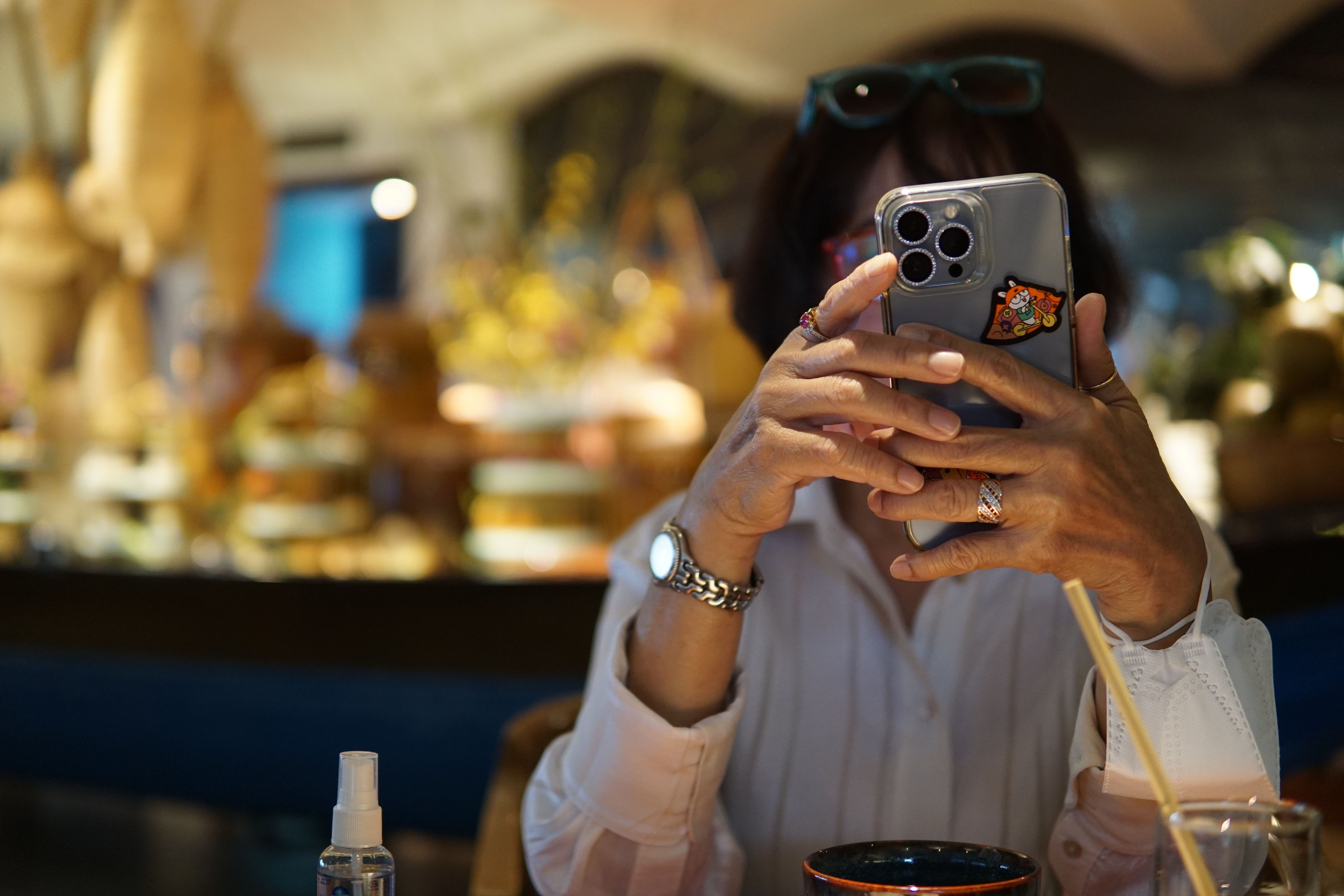
There's a tranquility to sitting in a dimly lit dining room, chatting with friends. The murmur of other guests is just loud enough for privacy, without needing to shout. But, like a burst of lightning, a camera flash or ring light across the room can jolt you out of that peace. Like vultures, phones hover over dishes, hungrier than their holders, ready to document dinner.
Tina Vaughn, co-owner of Eulalie, fights to preserve this serenity at her Tribeca restaurant.
“Phones are such a distraction,” she says. “You’re not supposed to be on your telephone. You’re supposed to be looking at your beautiful people at the table, enjoying food, and taking a breather from your day.”
At her French-leaning eatery in Lower Manhattan, she and her husband, Chef Chip Smith, encourage guests to “please [put their] cell phones on a holiday.”
Vaughn tells me that most of the diners are ready and willing to comply. “Nine times out of ten, almost every single person does it on their own and also comments on the appreciation they have to encourage people to be in the moment and be present.”
Of all her guests, Vaughn shares that “it’s the younger set that loves it.” She posits that “they have grown up with so much use on the phone that they’re finally getting over it.”
For the past few years, certain sects of young adults have been trying to adopt more analog technological habits. Whether they’re bringing back disposable cameras and flip phones, ditching their smartwatches, or even inventing products like the Brick, which puts a hard block on their screen time, Gen Z is feeling the weight of being exposed to technology since birth.
A study conducted by Talker Research found that 50% of the 2000 Americans surveyed were actively seeking to disconnect from their phone. At the helm of people seeking a digital detox were Gen Z, with 63% of those surveyed looking to unplug, closely followed by Millennials at 57%.
Vaughn and her team are outliers in the New York City dining scene. While her guests’ phones are on vacation, other restaurants are flooded with devices working overtime to document their wielders’ experience.
Doom Scrolling on TikTok can show users thousands of results of people dining at, or even just trying to walk into, some of the most popular restaurants in the city, like The Corner Store or Four Charles Prime Rib. Some videos show hopeful diners sharing that they arrive up to two hours before doors open.
Restaurants that the algorithm favors become impossible to book with reservations appearing to vanish within seconds upon release. Gaining access to these elusive temples becomes a badge of honor for New York City diners and a content gold mine for influencers.
With the democratization of food criticism through TikTok reviews and the review app Beli, diners have more opportunities to document and share their meals and opinions than ever. Eaters plugged into the zeitgeist can collect new restaurants like Pokémon cards with photos of their dinner as one of the only markers to say “I was here.”
Some restaurants are abandoning this model by prohibiting pictures in their establishments, if they aren’t so bold as to outright ask their guests to keep their phones out of sight.
In February 2024, Liz Johnson opened Frog Club. The now-shuttered eatery started by taking reservations only through a secret email request line. When patrons arrived, a doorman would place stickers over their cameras to enforce a photo-free environment.
Entering the restaurant was like stepping into Wonderland. Big banquettes filled the historic Chumley’s space to lull guests into the dimly-lit den surrounded by wall-to-wall murals of technicolor frogs hailing cabs, smoking cigars, and playing poker. A collection of plates dangled from the ceiling overhead, attached by thick industrial chains that hung like stalactites. As if the theming wasn’t clear enough, tiki-style cocktails were presented in frog-shaped mugs, and a giant stuffed frog sat at the ready to fill empty seats at large tables.
As guests, the instinct to pull out our phones to take pictures of the food and interior was limited, so instead, my friends and I put our phones away, took in the surroundings, and chatted the night away over a bottle of Rioja.
Johnson isn’t the first to implement a no-photo policy, though. Some of New York’s most lauded sushiya, like Masa and Sushi Sho, strictly prohibit any photography. And, in Vaughn’s view, no phones means no pictures, too.
“You’ll remember everything it meant to you,” she tells me. “Your memory kicks in in a different sensual way that fills your spirit up more. If you take pictures of everything, it allows you to forget that sensation.”
Instead, Vaughn would like her guests to come into the restaurant and “don’t be distracted. Just enjoy dinner and your friends.”

I am so ambivalent about this. Taking photos (sans flash) of restaurants and their dishes and menus is a professional necessity for me. At the same time, I know I am compromising another aspect of the experience.